

An agent passes its eval suite on Monday. On Tuesday, with the same code, the same prompts and the same model, one case fails. Nothing is broken: the agent chose a different tool order, or the judge read the answer differently. A single run per case tells you whether that run went well. It does not tell you whether the agent can do the task, or whether it does the task every time.
Two numbers answer those two questions: pass@k and pass^k. Google's Agent Development Kit (ADK) for Python reports both since version 2.15.0, released on 19 November 2026. In the invented example below, two versions of the same agent have the same pass rate of 0.55. One has a pass^3 of 0.350, the other 0.075. The pass rate alone would call them equal.
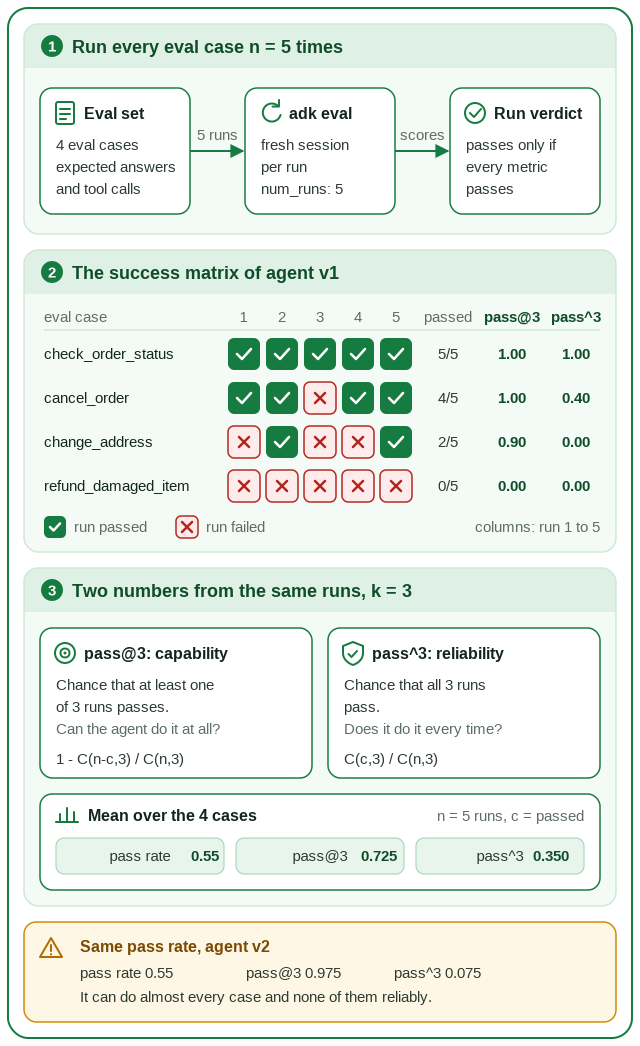
Read the figure from top to bottom: repeated runs, the success matrix they produce, and the two numbers computed from it.
What ADK 2.15 adds#
ADK already had multi-run evaluation. Since 2.14, multi_run_config (or adk eval --num_runs) runs each eval case several times and combines the results. Each run starts from a fresh session. The same release moved the mature evaluation classes out of experimental status. What was missing was a standard way to say "can pass" versus "always passes".
The 2.15.0 release notes list three evaluation changes for this:
- Two new methods for
cross_run_criteria:pass_at_k(printed as pass@k) andpass_hat_k(printed as pass^k), each with its ownk. - A mean over the eval set.
adk evalprints the mean of every cross-run criterion under each eval set's pass and fail counts. - A summary per case. A multi-run evaluation prints a per-case summary table by default and saves
MultiRunCaseSummaryresults in the.evalset_result.jsonfile.
The same release adds partial credit per tool argument (tool_parameter_match) and sandboxes scoped per user or session. As of 28 November 2026 the one patch since, 2.15.1 of 25 November (UTC), has no evaluation changes, and nothing marks the new methods as experimental.
pass@k and pass^k in plain words#
Run a case n times and count c passing runs. Now imagine drawing k of those n runs at random.
- pass@k is the chance that at least one of the k runs passed. It measures capability: can the agent solve this task at all?
- pass^k is the chance that all k runs passed. It measures reliability: does the agent solve it every time?
Both are computed by counting, over all ways to pick k runs from the n, the share of picks that contain a pass (pass@k) or only passes (pass^k):
The first is the unbiased estimator from the HumanEval paper by Chen et al. (2021). The second comes from τ-bench by Yao et al. (2024), which introduced pass^k to measure how consistently an agent passes the same task over repeated trials. ADK's implementation uses exactly these two expressions.
Three properties matter in practice:
- At k = 1 both equal the pass rate. The difference shows only for k of 2 or more.
- Per case, they add no new information. All three numbers depend only on n and c. Their value appears in the mean over the eval set: a set with one solid case and one coin-flip case has a very different mean pass^k from a set where every case fails now and then, at the same mean pass rate.
- The gap is the signal. A case with a high pass@k and a low pass^k is flaky, not wrong. A case with both at 0 is wrong.
How ADK counts the runs#
The new methods count runs of the whole eval case: a run passes only when every metric in criteria passed in it. The rules worth knowing:
- Undecided runs are left out. A run in which any metric was not evaluated counts as neither passed nor failed. n is the number of runs that passed or failed.
- Crashed runs are left out too, and by default fail the case.
max_crashed_runs(default 0) sets how many crashes a case tolerates.adk evaldoes not retry a crashed run. - Fewer than k decided runs means no value. The case is then left out of the eval set mean, and the summary line says how many cases the mean covers.
- Without a
thresholdthe criterion only reports. Its status is informational and the case verdict comes from the metrics. With athreshold, the criterion can fail the case. - k is checked early. When k is larger than the number of runs,
adk evalstops before any inference, so a typo does not cost a full eval run.
Where it is useful, and where not#
Useful:
- Regression gates for agents. Put the cases that must always work, such as a cancellation or a payment step, in an eval set of their own with a pass^k threshold, and let the other sets report only.
- Comparing versions. A new prompt or model that keeps the pass rate but lowers the mean pass^k has made the agent less predictable. The pass rate alone hides that.
- Deciding on retries. A case with a high pass@k and a low pass^k may be worth a retry or a verifier step. A case with a low pass@k needs a fix, not a retry.
Not useful, or with care:
- Deterministic code paths. If a case cannot vary, five runs cost five times as much and add nothing.
- Judge-based metrics. When a metric asks a model for a verdict, the judge's variance becomes part of the run verdict. A low pass^k can come from the judge as well as from the agent.
- Small n. With five decided runs, pass^3 of a case can only be 0, 0.1, 0.4 or 1. Treat values from a few runs as a rough signal, not as a measurement.
- Cost. Every run is a full agent session: n runs multiply the model calls, tool calls and cost of the eval by n. The runs can execute concurrently (
--parallelism), so wall-clock time grows less.
Example: compute both from a success matrix#
The script below takes the matrix from the figure, one string per eval case with one letter per run, and computes the pass rate, pass@3 and pass^3 per case. It then compares the means of two agent versions. The run results are invented; the arithmetic is the same as in ADK. I ran it with Python 3.12.14 and the standard library only.
"""pass@k and pass^k from a success matrix: one row per eval case, one letter per run.

P is a run that passed, F a run that failed. Standard library only.
"""
from math import comb

K = 3

AGENT_V1 = {
    "check_order_status":  "PPPPP",
    "cancel_order":        "PPFPP",
    "change_address":      "FPFFP",
    "refund_damaged_item": "FFFFF",
}
AGENT_V2 = {
    "check_order_status":  "PFPFP",
    "cancel_order":        "FPPPF",
    "change_address":      "PPFFP",
    "refund_damaged_item": "FPFPF",
}


def pass_at_k(n, c, k):
    """Chance that at least one of k runs, drawn from the n, passed."""
    return 1 - comb(n - c, k) / comb(n, k)


def pass_hat_k(n, c, k):
    """Chance that all k runs, drawn from the n, passed."""
    return comb(c, k) / comb(n, k)


def scores(matrix, k):
    rows = []
    for case, runs in matrix.items():
        n, c = len(runs), runs.count("P")
        rows.append((case, runs, c, n, c / n, pass_at_k(n, c, k), pass_hat_k(n, c, k)))
    return rows


def mean(values):
    return sum(values) / len(values)


rows = scores(AGENT_V1, K)
print(f"agent v1, {len(rows[0][1])} runs per case, k = {K}")
print(f"{'case':<21} {'runs':<6} {'passed':>6} {'rate':>5} {'pass@3':>7} {'pass^3':>7}")
for case, runs, c, n, rate, p_at, p_hat in rows:
    print(f"{case:<21} {runs:<6} {f'{c}/{n}':>6} {rate:>5.2f} {p_at:>7.2f} {p_hat:>7.2f}")
print()
print(f"{'mean over the eval set':<22} {'rate':>5} {'pass@3':>7} {'pass^3':>7}")
for name, matrix in (("agent v1", AGENT_V1), ("agent v2", AGENT_V2)):
    r = scores(matrix, K)
    print(f"{name:<22} {mean([x[4] for x in r]):>5.3f} "
          f"{mean([x[5] for x in r]):>7.3f} {mean([x[6] for x in r]):>7.3f}")
Run it:
python3.12 pass_k.pyThe output, from a run on 28 November 2026:
agent v1, 5 runs per case, k = 3
case                  runs   passed  rate  pass@3  pass^3
check_order_status    PPPPP     5/5  1.00    1.00    1.00
cancel_order          PPFPP     4/5  0.80    1.00    0.40
change_address        FPFFP     2/5  0.40    0.90    0.00
refund_damaged_item   FFFFF     0/5  0.00    0.00    0.00

mean over the eval set  rate  pass@3  pass^3
agent v1               0.550   0.725   0.350
agent v2               0.550   0.975   0.075
What the numbers say:
- Agent v1 has one case it never solves (pass@3 of 0) and one it always solves. Its failures are concentrated, so they are easy to find and fix.
- Agent v2 can solve almost everything (pass@3 of 0.975) and solves nothing reliably (pass^3 of 0.075). Its failures are spread over every case.
- cancel_order in v1 passes four runs in five, yet pass^3 is only 0.40: of the ten possible sets of three runs, only four hold no failure.
The same in ADK#
In ADK the matrix comes from adk eval. The configuration below follows the eval config guide of 2.15.0, with five runs and k = 3. I did not run it here: the agent behind it needs a model endpoint and credentials.
{
  "criteria": {
    "tool_trajectory_avg_score": 1.0,
    "response_match_score": 0.6
  },
  "multi_run_config": {
    "num_runs": 5,
    "cross_run_criteria": [
      {"method": "pass_at_k", "k": 3},
      {"method": "pass_hat_k", "k": 3, "threshold": 0.4}
    ]
  }
}
The first criterion only reports. The second fails a case whose pass^3 is below 0.4: for agent v1, cancel_order meets it at exactly 0.4, and change_address and refund_damaged_item fail it. The threshold applies to every case in the eval set, so keep a set like this for the cases that must always work. Run it with the agent folder and the eval set file:
pip install "google-adk[eval]==2.15.1"
adk eval ./support_agent ./support_agent/support.evalset.json \
  --config_file_path ./support_agent/test_config.json --num_runs 5
ADK requires Python 3.11 or later. According to the guide, the run summary then prints, under the pass and fail counts of each eval set, one line per criterion with its mean to two decimals, in the form pass^3: 0.35 (mean over 4 cases). For agent v1 the pass@3 line would read 0.72: the mean 0.725 is stored as a float just below 0.725. The --num_runs flag overrides num_runs in the file. A misspelled key inside multi_run_config makes the file fail to load, but a misspelled multi_run_config itself is silently dropped: the pass@k and pass^k lines are missing, and without --num_runs every case runs once.
Pros, cons and limits#
| Aspect | Details |
|---|---|
| Pros | Standard definitions from HumanEval and τ-bench, so the numbers mean what the literature means by them. Capability and reliability from the same runs. Means over the eval set show whether failures are concentrated or spread. Report-only by default, so adding them does not change existing verdicts. |
| Cons | n runs cost n times the model and tool calls. Judge-based metrics add their own variance to the run verdict. With a few runs, the values are coarse. |
| Limits | Only in cross_run_criteria and only in adk eval: AgentEvaluator, which pytest suites call, and adk web ignore these keys for now. Crashed and undecided runs are left out of n, which can make a case look better than its raw run log. |
| Maturity | New in 2.15.0, one patch release since, as of 28 November 2026. The mature evaluation classes left experimental status in 2.14. |
| Lock-in | Low. The two formulas take a few lines in any language, as the example shows; ADK provides the runs, the counting rules and the reporting. |
When to use it#
Turn on multi-run evaluation with pass^k for any agent whose eval cases can vary between runs, which is most agents with a model in the loop. Start report-only, look at the gap between pass@k and pass^k per case, and add a threshold only to an eval set of cases where every run must work. If your tests run under pytest through AgentEvaluator, compute the two numbers yourself from the per-run verdicts until ADK supports them there, and raise its num_runs, which defaults to 2, to at least k.
Next step: read the pass@k and pass^k section of the eval config guide (opens in a new tab), then run your existing eval set with --num_runs 5 before you change any threshold.