

A support assistant runs on Chat Completions. It sends the transcript and a list of function tools, gets tool_calls back, runs them and appends tool messages. You change the model name to gpt-6.2-sol and the tools no longer work there: on 17 November 2026 OpenAI released GPT-6.2 Astra and GPT-6.2 Sol, and for both models tool calling requires the Responses API. Chat Completions still serves them, but only without tools.
The move is more than a new endpoint. The Responses API works with typed items instead of messages, returns reasoning items you carry into the next call, and with GPT-6.2 it drops that reasoning when you edit earlier history.
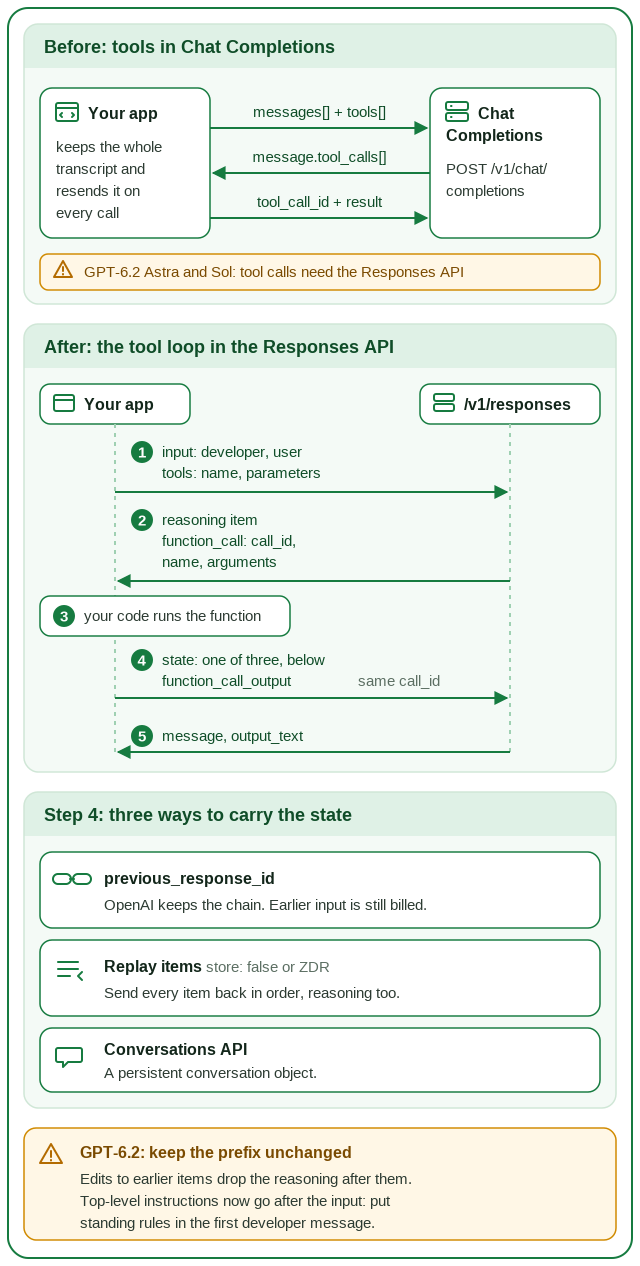
The figure shows where you end up. The top panel is the code you have, the middle panel is the loop you move to, and the bottom panel is the choice you make at step 4.
What GPT-6.2 is#
GPT-6.2 is a family of two reasoning models. gpt-6.2-astra is meant for the most demanding reasoning and coding work, gpt-6.2-sol for everyday coding and agent workflows at a lower price. The changelog entry of 17 November 2026 lists both for the Responses and Chat Completions endpoints, with no beta or preview label. Both take text and images and return text.
From the Astra (opens in a new tab) and Sol (opens in a new tab) model pages, as of 28 November 2026:
| GPT-6.2 Astra | GPT-6.2 Sol | |
|---|---|---|
| Input / output per 1M tokens | $8 / $40 | $2 / $10 |
| Cached input per 1M tokens | $0.40 | $0.10 |
| Cache writes per 1M tokens (30 min) | $10 | $2.50 |
| Context window | 1,050,000 | 1,050,000 |
| Max input tokens | 922,000 | 922,000 |
| Max output tokens | 128,000 | 128,000 |
These are Standard rates for requests up to 272K input tokens. Above that, input and cache rates double and output costs 1.5 times as much, for the whole request.
Three changes matter for an app that calls tools:
- Tool calling only in Responses. Chat Completions accepts GPT-6.2 requests without tools.
- Prefix edits drop reasoning. The Responses API drops reasoning items after edits to earlier conversation history, after certain model changes (downgrades included), and after a change of end user or organization.
- Instructions move. The top-level
instructionsfield is now appended after the input.
How the tool loop works in the Responses API#
The loop has the same five steps as before, with different shapes:
- You send
input, a string or a list of items, andtools. A function tool hasname,descriptionandparametersat the top level, not under afunctionkey. - The response holds an
outputarray of items. Next to amessageit can holdreasoningitems andfunction_callitems, each with acall_id, anameand the arguments as a JSON string. - Your code runs the function.
- You send the result as a
function_call_outputitem with the samecall_id. For reasoning models, the reasoning items returned with a tool call go back with the tool result. - The model answers with a
message, or asks for more tool calls. The SDK helperoutput_textcollects the text.
Step 4 needs the earlier context, and the migration guide gives three ways to provide it:
previous_response_id. Responses are stored by default, so you send only the new items and point at the last response. All earlier input tokens in the chain are still billed as input.- Replay the items yourself. With
store: falseyou send every output item back, in order, reasoning items included. Those carryencrypted_contentby default. With Zero Data Retention this is the route: the API treatsstoreas false. - Conversations API. A persistent conversation object, for when you need one.
What maps to what#
| Chat Completions | Responses API |
|---|---|
POST /v1/chat/completions | POST /v1/responses |
messages[] | input, a string or a list of items |
| system message | first developer message in input |
tools[].function.name, .parameters | tools[].name, .parameters |
message.tool_calls[] | function_call items in output |
role: "tool" with tool_call_id | function_call_output with call_id |
| functions non-strict by default | strict mode attempted when strict is omitted |
response_format | text.format |
reasoning_effort | reasoning.effort |
n | not available: send separate requests |
choices[0].message.content | output_text, or the output items |
Streaming changes too: Responses sends typed events such as response.output_text.delta and response.function_call_arguments.delta, so a handler written for Chat Completions chunks does not carry over.
GPT-6.2 adds its own parameter rules, from the migration quickstart:
- Omit
temperature,top_pandtop_logprobs, and removemessage.output_text.logprobsfrominclude. - Replace reasoning effort
noneorminimalwithlow; the model pages state that the API rejectsnone. For a new integration, start atmedium. - Coming from GPT-5.5 or earlier, replace
prompt_cache_retentionwithprompt_cache_options.ttlset to"30m". - GPT-6.2 does not support Flex processing (
service_tier: flex).
Example: convert a request#
The script below converts one Chat Completions request, in the middle of a tool call, into the Responses request that continues it. It maps messages and tools, applies the effort rule, drops the unsupported sampling parameters and lists every other key for you to convert by hand. It uses only the standard library and sends nothing. I ran it with Python 3.12.14.
"""Turn a Chat Completions tool-calling request into a Responses API request.

Standard library only. Nothing is sent to an API.
"""
import json

DROP = ("temperature", "top_p", "logprobs", "top_logprobs", "n")
HANDLED = ("model", "messages", "tools", "reasoning_effort", "parallel_tool_calls")


def convert_tool(tool):
    fn = tool["function"]
    return {
        "type": "function",
        "name": fn["name"],
        "description": fn.get("description", ""),
        "parameters": fn.get("parameters", {"type": "object", "properties": {}}),
        # Chat Completions is non-strict by default. Responses tries strict
        # mode when strict is omitted, so keep the old behaviour explicit.
        "strict": fn.get("strict", False),
    }


def convert_messages(messages):
    items = []
    for msg in messages:
        if msg["role"] == "system":
            items.append({"role": "developer", "content": msg["content"]})
        elif msg["role"] == "assistant" and msg.get("tool_calls"):
            if msg.get("content"):
                items.append({"role": "assistant", "content": msg["content"]})
            for call in msg["tool_calls"]:
                items.append({"type": "function_call", "call_id": call["id"],
                              "name": call["function"]["name"],
                              "arguments": call["function"]["arguments"]})
        elif msg["role"] == "tool":
            items.append({"type": "function_call_output",
                          "call_id": msg["tool_call_id"], "output": msg["content"]})
        else:  # text content only: image parts need their own conversion
            items.append({"role": msg["role"], "content": msg["content"]})
    return items


def convert_request(old, model):
    new = {"model": model, "input": convert_messages(old["messages"]),
           "tools": [convert_tool(t) for t in old.get("tools", [])]}
    # GPT-6.2 rejects "none": the migration quickstart says use "low" instead.
    effort = old.get("reasoning_effort", "medium")
    new["reasoning"] = {"effort": "low" if effort in ("none", "minimal") else effort}
    if "parallel_tool_calls" in old:
        new["parallel_tool_calls"] = old["parallel_tool_calls"]
    dropped = [key for key in DROP if key in old]
    by_hand = [key for key in old if key not in DROP + HANDLED]
    return new, dropped, by_hand


chat_request = {
    "model": "gpt-5.6-terra",
    "reasoning_effort": "none",
    "temperature": 0.2,
    "max_completion_tokens": 400,
    "messages": [
        {"role": "system", "content": "You answer order questions."},
        {"role": "user", "content": "Where is order A-1042?"},
        {"role": "assistant", "content": None, "tool_calls": [
            {"id": "call_7", "type": "function",
             "function": {"name": "get_order", "arguments": "{\"order_id\":\"A-1042\"}"}}]},
        {"role": "tool", "tool_call_id": "call_7",
         "content": "{\"status\":\"shipped\",\"date\":\"2026-11-26\"}"},
    ],
    "tools": [{"type": "function", "function": {
        "name": "get_order", "description": "Look up an order by id.",
        "parameters": {"type": "object", "properties": {"order_id": {"type": "string"}},
                       "required": ["order_id"], "additionalProperties": False}}}],
}

request, dropped, by_hand = convert_request(chat_request, "gpt-6.2-sol")
print("POST /v1/responses")
print("model:", request["model"], " reasoning:", request["reasoning"])
print("input:")
for item in request["input"]:
    print("  " + json.dumps(item))
print("tools:")
for tool in request["tools"]:
    print("  " + json.dumps({k: v for k, v in tool.items() if k != "parameters"}))
print("dropped:", dropped)
print("not converted, check by hand:", by_hand)
The output of python3.12 to_responses.py, run on 28 November 2026:
POST /v1/responses
model: gpt-6.2-sol  reasoning: {'effort': 'low'}
input:
  {"role": "developer", "content": "You answer order questions."}
  {"role": "user", "content": "Where is order A-1042?"}
  {"type": "function_call", "call_id": "call_7", "name": "get_order", "arguments": "{\"order_id\":\"A-1042\"}"}
  {"type": "function_call_output", "call_id": "call_7", "output": "{\"status\":\"shipped\",\"date\":\"2026-11-26\"}"}
tools:
  {"type": "function", "name": "get_order", "description": "Look up an order by id.", "strict": false}
dropped: ['temperature']
not converted, check by hand: ['max_completion_tokens']
What to notice:
call_idis the link. The call and its output are two separate items, joined by id.strict: falseis a choice. It keeps the Chat Completions behaviour. Moving to strict mode is worth doing, but as its own change and with its own test.- No reasoning items yet. Chat Completions never returned any, so the converted history has none. From the first Responses call on, they appear in
outputand must be kept.
I did not send the converted request to the API; the shapes follow the official migration and function calling guides.
The loop that continues from here, adapted from the official function calling guide (opens in a new tab) and not run here. run_tool is your own dispatcher:
import json
from openai import OpenAI

client = OpenAI()
items, tools = request["input"], request["tools"]

response = client.responses.create(model="gpt-6.2-sol", input=items, tools=tools,
                                   reasoning=request["reasoning"])
while any(item.type == "function_call" for item in response.output):
    items += response.output  # keeps reasoning and calls, in order
    for item in response.output:
        if item.type == "function_call":
            result = run_tool(item.name, json.loads(item.arguments))
            items.append({"type": "function_call_output",
                          "call_id": item.call_id, "output": json.dumps(result)})
    response = client.responses.create(model="gpt-6.2-sol", input=items, tools=tools,
                                       reasoning=request["reasoning"])

items += response.output  # keep the answer too, for the next user turn
print(response.output_text)
This is the replay option, so it also works with store=False. The model, tools and effort stay the same on every call, which keeps the prefix unchanged.
Keep the prefix unchanged#
In my view this is the most expensive GPT-6.2 change to miss. The prefix of a reasoning item is everything that comes before it in the conversation. Change that history and the API drops the reasoning items that follow the change. The model then may redo work, which costs tokens, latency and possibly quality, and the prompt cache stops matching at the same point.
The common prefix changes and the append-only alternative from the official guide:
| You change | Do this instead |
|---|---|
reasoning.effort between turns | append a configuration_update item |
the text.format schema | append a configuration_update item |
the tools list | append an additional_tools item, or limit with tool_choice and allowed_tools |
| the first developer message | append a new developer message at the end |
| truncated old tool outputs or images | shorten them before the first send, or use OpenAI compaction |
Two more rules:
- Standing rules go first. Put reusable instructions in the first
developermessage ininput, where they are eligible for caching. Use top-levelinstructionsonly for guidance that applies to the current request; its tokens are billed at the uncached input rate. - Check what was removed. The response field
input_transformationslists the reasoning items the API removed and why, for exampleprefix_mismatch. Prompt Cache Diagnostics, withprompt_cache_options.comparison_response_id, shows on a best-effort basis where the cache stopped matching.
Where it helps, and where not yet#
Move now:
- Agents and assistants that call function tools on GPT-6.2. There is no other route.
- Long tool loops. Reasoning carries across tool calls instead of being rebuilt on every request.
- Built-in tools. Web search, file search, code interpreter and remote MCP servers run in the Responses API, next to your own functions.
Wait, or migrate one flow at a time:
- Text-only flows. They keep working on Chat Completions with GPT-6.2. The guide allows moving one flow at a time and starts its checklist with a text flow, so these are a low-risk first step rather than urgent.
- History that is rewritten. Sliding windows, in-place summaries and truncated tool outputs now also cost reasoning, on top of the cache misses they always caused. Redesign them as append-only first, or accept the cost knowingly.
- One code path for several providers. If the same client also talks to other servers in the Chat Completions format, Responses is a second code path to maintain. That is my assessment, not a statement in the docs.
Pros, cons and limits#
| Aspect | Details |
|---|---|
| Pros | One loop for your functions and the built-in tools. Reasoning carried between tool calls. A stateless option with encrypted reasoning for Zero Data Retention. OpenAI reports 40 to 80% better cache use than Chat Completions in its internal tests. |
| Cons | Not a drop-in change: request, output, tool definitions, streaming events and the structured output field all move. Patterns that rewrite history now lose reasoning. |
| Limits | previous_response_id does not make earlier input free. GPT-6.2 has no temperature, top_p or logprobs, rejects effort none, and has no Flex processing. |
| Lock-in | Stored responses and encrypted reasoning live on OpenAI's side; moving away means rebuilding that state. Text-only message inputs are compatible between the two APIs. |
When to migrate#
If an app needs GPT-6.2 and tools, migrate: Chat Completions is not an option for that combination. Start with one flow, choose how you carry state, and check input_transformations on real traffic before you send more to it. An app that rewrites its history needs that redesign first, or it pays for GPT-6.2 without getting its reasoning across turns.
Next step: the GPT-6.2 migration quickstart (opens in a new tab), then the Responses migration guide (opens in a new tab) with its rollout checklist.