

A support ticket comes in and your code has to decide three things: is this a hardware defect, which queue gets it, and how close is the customer to leaving. The usual answer is a prompt that asks a chat model to reply in JSON, followed by a parser and a retry when the reply does not fit. You pay for the output tokens, and you still get a label without a probability.
A decision model skips the text. You send the ticket and a set of typed questions, and you get one typed answer per question back:
{ "is_defect": { "type": "noul", "noul": 0.94, "confidence": 0.94 } }Google shipped this on 11 November 2026 as Gemini Decision 1 and the Decisions API. The output token count of every call is 0, and your code branches on the numbers directly.
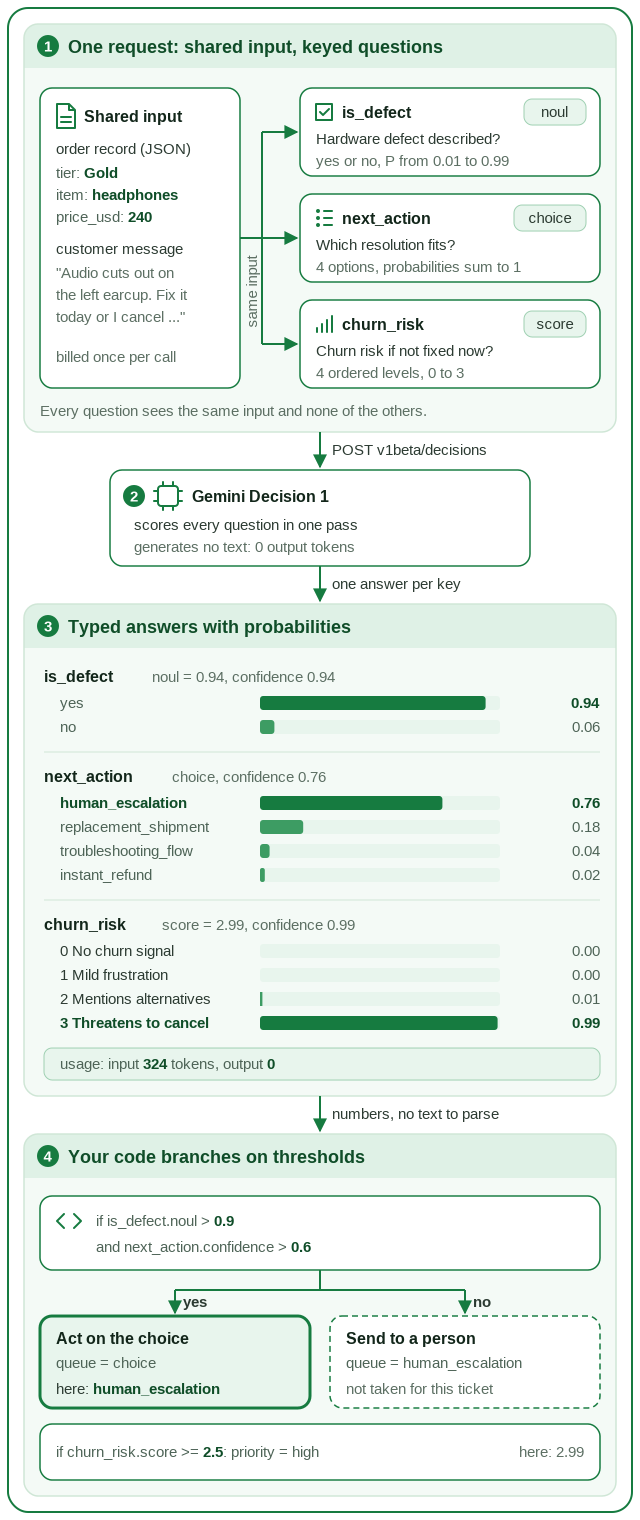
Read the figure top to bottom: the shared input fans out to three keyed questions, the model scores them in one pass, each key comes back with probabilities, and ordinary code turns those into a queue.
What Gemini Decision 1 and the Decisions API are#
Gemini Decision 1 (gemini-decision-1) is a model built for one job: evaluate closed questions over an input and return probabilities. It reads text, PDFs, images, audio and video. It does not generate text, call functions or think, and its output token limit is 0.
The Decisions API is the endpoint in front of it: POST https://generativelanguage.googleapis.com/v1beta/decisions, or client.decisions.create in the google-genai SDK from version 3.2. One call carries a shared input and a map of 1 to 1,000 questions. Each answer comes back under the key you gave its question.
Status, as of 28 November 2026: released on 11 November 2026, on the Gemini Developer API under v1beta only. The model string has Google's stable form (no -preview suffix), but no page says generally available. My reading: treat the endpoint as beta, since the request shape can still change.
How a decision request works#
Every question has a type, instructions (the full question in words) and criteria, required for choice and score and optional for noul:
| Type | Asks | Returns |
|---|---|---|
noul | Does a statement hold? | noul: probability of yes, from 0.01 to 0.99, plus confidence |
choice | Which of 2 to 255 options applies? | the top choice, probabilities for every option (summing to 1), confidence |
score | Where on 2 to 255 ordered levels? | score: the probability-weighted average of the level indices, probabilities per level, a legend, confidence |
Confidence is the probability of the top outcome, or max(noul, 1 - noul) for a yes/no question. Google calls these probabilities calibrated, and its guide still says to set thresholds from labelled examples of your own traffic.
Four details change how you write questions:
- Questions are isolated. All run against the shared input in one forward pass, but none sees another or changes another's answer.
- The model never sees your keys.
is_defectis for your code. The question goes ininstructions. - Choice keys are sorted alphabetically by UTF-8 bytes, so
none_of_the_abovedoes not land last. Use a describedotherinstead. - A score is an average. A score of 1.12 on a three-level scale can hide a split between levels. Read the per-level probabilities when the decision depends on the level.
The shared input is billed once per request. Each question adds only the tokens of its own instructions, criteria and formatting. So many narrow questions in one call are cheap: atomic checks, combined in code.
Where it is useful, and where not#
Good fits:
- Routing. Pick a queue, a model, an agent or a tool from a fixed list, and fall back to a person when confidence is low.
- Moderation and policy checks. One yes/no question per rule, all in one call, each with its own threshold.
- Grading. Score a candidate answer, a retrieval hit or a call recording against a rubric, then rank or filter on the score.
- Agent control. Decide whether to escalate, compact the context or stop.
Poor fits:
- Anything open. Extraction into your own schema, summaries, explanations and tool calls with arguments still need a generative model with structured output.
- Arithmetic and dates. The guide says to compare numbers, dates and durations in code and pass the result in the input.
- Dependent questions. A question cannot read another answer. Make a second call, or ask both and ignore one.
- "None of these". A choice question spreads probability over your options even when none fits. Add a yes/no scope check.
Example: route a support ticket#
The request below is the multi-question example of the official guide, with its branching code replaced by a print. It needs a Gemini API key and the google-genai package, so it was not run here.
import json
from google import genai

client = genai.Client(http_options={"api_version": "v1beta"})

order = {"order": {"id": "8821", "item": "headphones", "price_usd": 240}, "tier": "Gold"}
message = {"message": "Audio cuts out on the left earcup. Fix it today or I cancel my membership."}

result = client.decisions.create(
    model="gemini-decision-1",
    input=[
        {"type": "text", "text": json.dumps(order) + "\n"},
        {"type": "text", "text": json.dumps(message)},
    ],
    questions={
        "is_defect": {"type": "noul",
                      "instructions": "Does `message` describe a hardware defect?"},
        "next_action": {"type": "choice",
                        "instructions": "What is the right resolution given `tier` and `order`?",
                        "criteria": {
                            "instant_refund": "Refund without return. Low value or clear fault.",
                            "replacement_shipment": "Ship a replacement. Customer returns the original.",
                            "troubleshooting_flow": "The issue may be fixable by the customer.",
                            "human_escalation": "",
                        }},
        "churn_risk": {"type": "score",
                       "instructions": "How likely is the customer to churn if the issue is not resolved now?",
                       "criteria": ["No churn signal", "Mild frustration",
                                    "Mentions alternatives", "Threatens to cancel"]},
    },
)
print(result.answers["next_action"].choice, result.answers["next_action"].confidence)
The script below takes the example response published in the guide, the same values as in the figure, and routes on it with the guide's 0.9 and 0.6 thresholds plus a churn threshold of my own. It needs only the standard library.
"""Route a support ticket on a Decisions API response. Standard library only."""
import json

# The example response of the "Ask multiple questions" section of the
# Gemini Decisions API guide, as published in November 2026 (usage trimmed).
DOCS_RESPONSE = json.loads("""
{
  "answers": {
    "is_defect": {"type": "noul", "noul": 0.94, "confidence": 0.94},
    "next_action": {
      "type": "choice",
      "choice": "human_escalation",
      "probabilities": {"human_escalation": 0.76, "replacement_shipment": 0.18,
                        "troubleshooting_flow": 0.04, "instant_refund": 0.02},
      "confidence": 0.76
    },
    "churn_risk": {
      "type": "score",
      "score": 2.99,
      "legend": {"0": "No churn signal", "1": "Mild frustration",
                 "2": "Mentions alternatives", "3": "Threatens to cancel"},
      "probabilities": {"0": 0.0, "1": 0.0, "2": 0.01, "3": 0.99},
      "confidence": 0.99
    }
  },
  "usage": {"total_input_tokens": 324, "total_output_tokens": 0, "total_tokens": 324}
}
""")

DEFECT_MIN = 0.9   # P(yes) needed to treat the ticket as a hardware defect
ACT_MIN = 0.6      # confidence needed to act without a person
URGENT_MIN = 2.5   # churn score from which the ticket jumps the queue


def route(answers):
    defect = answers["is_defect"]
    action = answers["next_action"]
    churn = answers["churn_risk"]
    if defect["noul"] > DEFECT_MIN and action["confidence"] > ACT_MIN:
        queue = action["choice"]
    else:
        queue = "human_escalation"
    level = max(churn["probabilities"], key=churn["probabilities"].get)
    priority = "high" if churn["score"] >= URGENT_MIN else "normal"
    return queue, priority, churn["legend"][level]


usage = DOCS_RESPONSE["usage"]
print(f"tokens: input={usage['total_input_tokens']} output={usage['total_output_tokens']}")
queue, priority, churn_level = route(DOCS_RESPONSE["answers"])
print(f"queue={queue} priority={priority} churn level: {churn_level}")
The output, from a run on 28 November 2026 with Python 3.12.14:
tokens: input=324 output=0
queue=human_escalation priority=high churn level: Threatens to cancel
Three things to notice:
- No parsing. The queue decision is two comparisons on floats.
- Two thresholds, two jobs.
DEFECT_MINdecides what the ticket is,ACT_MINwhether a machine may act on it. Tune each against labelled tickets. - The level comes from the probabilities.
routedoes not round the score, which can point at the wrong level on a split distribution.
As an illustration of cost: at the paid input price of $0.10 per million tokens, a 324-token call like this one costs about $0.00003, so a million such tickets cost about $32 in model fees.
The same pattern at OpenAI and Ollama#
Google is not alone. The OpenAI changelog (opens in a new tab) lists its Decisions API as generally available on 22 October 2026, and Ollama runs decision models locally. As of 28 November 2026:
| Gemini Decisions API | OpenAI Decisions API | Ollama decision models | |
|---|---|---|---|
| Status | v1beta, released 11 Nov 2026 | GA since 22 Oct 2026 | local from v0.35.0; Clef also in Ollama's cloud |
| Model | gemini-decision-1 | gpt-6-luna | Nimble, Tev1, Clef, Clef Flash, AutoTrust |
| Yes/no type | noul | predicate | noul |
| Questions per call | 1 to 1,000 | up to 400 | up to 64 in the cloud |
| Answers | map by key | array, by question name | map by key |
| Prompt caching | no | yes | not documented |
Ollama v0.40.15 (opens in a new tab), released on 3 November 2026, added the AutoTrust family (autotrust-jev), supported on Apple silicon in that release. The Ollama docs (opens in a new tab) send decision requests to /v1/systemone, with state instead of input and smaller limits: 2 to 26 options and 2 to 10 levels. A local decision model keeps the input on your machine, which matters for moderation of private content.
Pros, cons and limits#
| Aspect | Details |
|---|---|
| Pros | Typed answers with probabilities, no parsing. Up to 1,000 isolated checks per call, input billed once. Multimodal, including audio without transcription. |
| Pricing | Input tokens only: $0.10 per million on the paid tier, plus a free tier (as of 28 November 2026). |
| Cons | v1beta on the Gemini Developer API only, with no GA label yet. One model. Free-tier data is used to improve Google's products; the paid tier is not. |
| Limits | 262,144 tokens across input and questions. No context caching, Batch, Flex or Priority, so a repeated input is billed in full. Text-only instructions. No YouTube or gs:// URIs, no conversation history or tool-call blocks. |
| Lock-in | The request shape is similar to Ollama's (keyed questions, noul, choice, score) and differs from OpenAI's (predicate, an answers array). Thresholds must be re-tuned per model. |
| Safety | A blocked input returns HTTP 400 with a code such as safety. A message can argue for its own classification, so keep a second check on high-stakes actions. |
When to choose it#
Choose a decision model when your code already reduces a model reply to a label, a yes/no or a number. Routing, policy checks and rubric scoring then cost input tokens only, need no parser and come with a probability to threshold. Keep a generative model with structured output for anything that has to produce text, extract fields or call tools.
Before production, set every threshold from labelled examples of your own traffic.
Next step: work through the Decisions API guide (opens in a new tab), starting with the section on multiple questions, and try your own questions in the Decisions Playground it links.