

A lot of model traffic has no one waiting for it: a nightly contract review, a repository scan, an evaluation run. They pay the same token rate as a chat reply, or move to a batch file of independent requests or a best-effort tier.
In the week of 16 November 2026 both Google and OpenAI added a cleaner option: send the request now, accept a result later, and pay less per token. Google's Deferred tier on the Interactions API takes 50% off with a 24-hour target. OpenAI's background mode in the Responses API now has a 2-hour window at 30% off and an 8-hour window at 40% off.
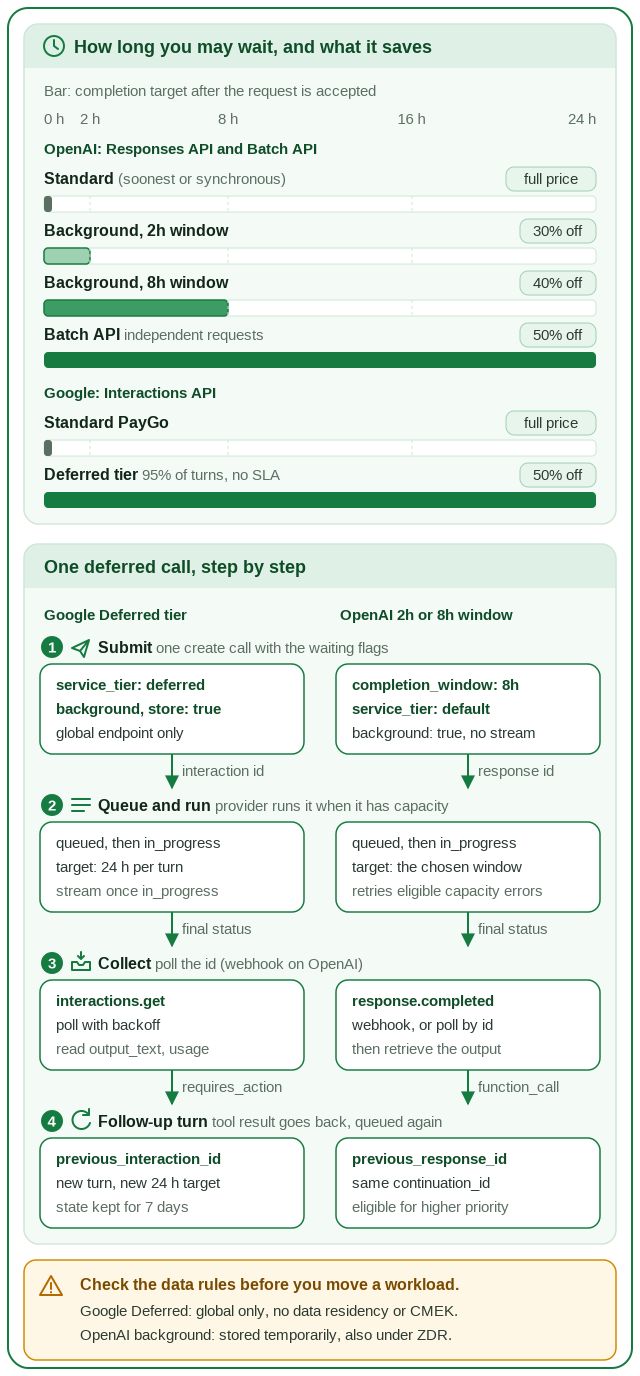
The figure puts both on one timeline. The top panel shows how long each option may take and what it saves; the bottom panel shows the four steps of a deferred call on each platform.
What was released#
Google Deferred tier. On 16 November 2026 Google made the Deferred tier generally available on Gemini Enterprise Agent Platform. You set service_tier to deferred on an Interactions API call, together with background and store, and the platform queues the turn. Deferred calls cost 50% less than Standard pay-as-you-go for input, output and thinking tokens. The same release puts whole Agent Development Kit (ADK) agents on the Deferred tier through ServiceTier.DEFERRED in their RunConfig (google-adk v2.10.0 or later).
OpenAI completion windows. On 17 November 2026 OpenAI added a completion_window choice to background mode in the Responses API, in public beta. The default soonest has no discount. 2h gives model token rates 30% below Standard, 8h gives 40% below. The beta covers GPT-6.2 Astra, GPT-6.2 Sol, GPT-6.1 Terra and GPT-6 Luna.
Flex is winding down. The same changelog entry says new models will not support Flex processing. Flex stays on its current models while the beta winds down; the Flex guide says a retirement date will follow. OpenAI points Flex users to the completion windows.
How it works#
Both tiers follow the four steps in the bottom panel of the figure. The create call returns at once with an id. The provider runs the request when it has capacity, and you collect the result by polling the id, or on OpenAI through a response.completed webhook. When the model asks for a tool, your code runs it and sends the result back as a new request that points at the previous one. Neither tier streams from the start: Google lets you attach a stream once a turn is in_progress, OpenAI does not stream 2h and 8h requests at all.
The differences are in the details:
| Google Deferred tier | OpenAI 2h and 8h windows | |
|---|---|---|
| Status | GA, 16 November 2026 | Public beta, 17 November 2026 |
| Discount | 50% on input, output and thinking tokens | 30% (2h) or 40% (8h) on model token rates |
| Target | 95% of turns within 24 hours, no SLA | Completion within the window, counted from acceptance |
| Required flags | service_tier: deferred, background: true, store: true | background: true, completion_window, Standard processing |
| Follow-up | previous_interaction_id | previous_response_id and the same continuation_id |
| State kept | 7 days | While the stored response is available; else replay input and output |
| Where | Global endpoint only | Supported models in the Responses API |
Two billing rules matter on Google: a single-call turn that fails, also by passing the 24-hour window, is not billed, and neither is a turn you cancel while it is still queued. The deferred discount also stacks with contract and implicit context caching discounts.
On OpenAI, 2h and 8h requests share the Batch/Background rate limit with Batch API jobs, and a Standard request cannot reuse prompt cache entries that a 2h or 8h request created.
Where it fits, and where it does not#
Good fits:
- Overnight document work. Reviews, extraction and summaries that someone reads the next morning. OpenAI's own example for the
8hwindow is exactly this. - Offline evaluations. Benchmarks and regression suites where cost matters and wall-clock time does not.
- Agent runs with tools. Code migrations and repository scans that need several turns. A batch line is one independent request; both new tiers support follow-up turns.
Poor fits:
- Anything interactive. If a person waits, use the synchronous tiers. A queued request can start hours later.
- Agents with many turns on a 24-hour target. Google applies the target per turn. An agent run of five turns can, in the worst case, take five days.
- Data that must stay in a region. Google's Deferred tier runs only on the global endpoint and does not support data residency, CMEK or zero data retention. OpenAI's background mode stores request data temporarily even under zero data retention. For EU workloads with residency requirements, check this before anything else.
Submit and collect#
Neither request below was run here, because both need a paid account. The Google request is the documented sample with a shorter prompt. The create call goes to the global endpoint of the Interactions API:
curl -X POST \
  -H "Authorization: Bearer $(gcloud auth print-access-token)" \
  -H "Content-Type: application/json; charset=utf-8" \
  -d '{
    "model": "gemini-4-argon",
    "input": "In two sentences, explain how a circuit breaker differs from exponential backoff.",
    "service_tier": "deferred",
    "background": true,
    "store": true
  }' \
  "https://aiplatform.googleapis.com/v1/projects/PROJECT_ID/locations/global/interactions"
The reply carries an interaction id and the status queued. Poll GET .../interactions/INTERACTION_ID until the status is final, then read output_text and usage. A tool request ends the turn as requires_action.
On OpenAI, the background mode guide describes the fields in prose. The request below puts them together and was not run either:
curl https://api.openai.com/v1/responses \
  -H "Content-Type: application/json" \
  -H "Authorization: Bearer $OPENAI_API_KEY" \
  -d '{
    "model": "gpt-6.1-terra",
    "input": "Review this contract for missing approvals: ...",
    "background": true,
    "service_tier": "default",
    "background_options": {
      "completion_window": "8h",
      "continuation_id": "contract-review-2026-11-28"
    }
  }'
service_tier must select Standard: with auto the request qualifies only if the API picks Standard. Leave stream unset. continuation_id is your own value; follow-ups that reuse it, with the same model, tier, window and project, are eligible for higher queue priority.
Example: which tier meets the deadline#
The cost is simple arithmetic. The deadline has a trap: the target applies per request, so tool calls multiply it. This script picks the cheapest tier per vendor that still meets a deadline, for a single-turn job and for a job with three turns. The discounts and targets are the published ones. The Standard rates are placeholders, not the price of a real model, so compare tiers within a vendor and not the two vendors. Treating every turn as if it uses its full window is my own planning assumption, not a vendor rule, and the cost ignores the extra tokens of later turns. Other consumption options, such as Google's Flex PayGo and batch inference or OpenAI's Flex on older models, are left out.
"""Cheapest tier that meets a deadline. Published discounts, placeholder rates."""
from dataclasses import dataclass


@dataclass(frozen=True)
class Tier:
    vendor: str
    name: str
    target_hours: int  # completion target per request, not an SLA
    discount: float  # off the Standard token rate
    follow_ups: bool  # can a tool result go back as a follow-up turn


TIERS = [
    Tier("OpenAI", "standard", 0, 0.00, True),
    Tier("OpenAI", "background 2h", 2, 0.30, True),
    Tier("OpenAI", "background 8h", 8, 0.40, True),
    Tier("OpenAI", "Batch API", 24, 0.50, False),
    Tier("Google", "Standard PayGo", 0, 0.00, True),
    Tier("Google", "Deferred", 24, 0.50, True),
]

# One night of document reviews. Tokens per request; turns do not change cost.
REQUESTS, INPUT_TOKENS, OUTPUT_TOKENS = 20_000, 6_000, 800
RATE_IN, RATE_OUT = 2.00, 8.00  # placeholder USD per million tokens


def cost(tier: Tier) -> float:
    standard = REQUESTS * (INPUT_TOKENS * RATE_IN + OUTPUT_TOKENS * RATE_OUT) / 1e6
    return standard * (1 - tier.discount)


def worst_case_hours(tier: Tier, turns: int) -> int:
    # Planning assumption: every turn may use its full target.
    return tier.target_hours * turns


def cheapest(vendor: str, deadline: int, turns: int) -> Tier:
    fits = [t for t in TIERS
            if t.vendor == vendor
            and (turns == 1 or t.follow_ups)
            and worst_case_hours(t, turns) <= deadline]
    return min(fits, key=cost)


print(f"Standard cost of the job: {cost(TIERS[0]):.2f} USD (placeholder rates)")
for deadline, turns in [(1, 1), (10, 1), (48, 1), (48, 3)]:
    print(f"\ndeadline {deadline} h, {turns} turn(s) per request")
    for vendor in ("OpenAI", "Google"):
        tier = cheapest(vendor, deadline, turns)
        worst = worst_case_hours(tier, turns)
        wait = f"worst case {worst} h" if worst else "synchronous"
        print(f"  {vendor:<7}{tier.name:<16}{cost(tier):>8.2f} USD   {wait}")
It needs only the standard library. The output of a run on 28 November 2026 with Python 3.12.14:
Standard cost of the job: 368.00 USD (placeholder rates)

deadline 1 h, 1 turn(s) per request
  OpenAI standard          368.00 USD   synchronous
  Google Standard PayGo    368.00 USD   synchronous

deadline 10 h, 1 turn(s) per request
  OpenAI background 8h     220.80 USD   worst case 8 h
  Google Standard PayGo    368.00 USD   synchronous

deadline 48 h, 1 turn(s) per request
  OpenAI Batch API         184.00 USD   worst case 24 h
  Google Deferred          184.00 USD   worst case 24 h

deadline 48 h, 3 turn(s) per request
  OpenAI background 8h     220.80 USD   worst case 24 h
  Google Standard PayGo    368.00 USD   synchronous
What the four cases show:
- A deadline in the same working day is where the OpenAI windows add something new. With 10 hours, the
8hwindow saves 40%. Of the two Google options in the script, only Standard fits. - With two days and one turn, both vendors reach 50%, through the Batch API on OpenAI and the Deferred tier on Google.
- With two days and three turns, the Batch API drops out because it has no follow-up turns, and the Deferred tier drops out because three 24-hour targets can add up to 72 hours. The
8hwindow still fits.
Pros, cons and limits#
| Aspect | Details |
|---|---|
| Pros | Up to half the token cost for work nobody waits for. Unlike a batch file, both tiers keep conversation state, so agents with tools can run on them. No new infrastructure: the same API and SDK with a few extra fields. |
| Cons | Targets, not SLAs. The data rules above (global only on Google, temporary storage on OpenAI). OpenAI's windows are beta and cover four models. |
| Limits | No streaming from the start. Google retains state for 7 days, so a chain resumed after that must start over. OpenAI 2h and 8h requests count against the Batch/Background rate limit, and Standard requests cannot reuse their prompt cache. Google Deferred calls share the Flex PayGo per-model quota. |
| Lock-in | Field names, statuses and follow-up mechanics differ per vendor (previous_interaction_id against previous_response_id and continuation_id). A thin job layer of your own (submit, store the id, collect, retry) keeps the vendor choice open. |
When to choose it#
Move a workload to a waiting tier when its result is read hours later and a target is good enough: nightly document work, evaluations, scans. On OpenAI, use 8h for overnight work and 2h for same-day work. On Google, the Deferred tier fits jobs that can wait a day, with few turns per run. Keep interactive work and region-bound data on the synchronous tiers. As of 28 November 2026 the OpenAI windows are beta, so expect changes, and if you still use Flex, plan the move now. Next step: read Google's Use the Deferred tier (opens in a new tab) page for the status values and billing rules, and OpenAI's background mode guide (opens in a new tab) for the follow-up flow with continuation_id.