

Three teams share one pool of vLLM pods on Kubernetes. A plain Service spreads their requests without knowing that one pod already holds the support agent's long system prompt in its KV cache, so another pod computes it again. Saturated pods queue requests, and nobody can say which team used how many tokens. The usual answer is a gateway you build yourself.
Kinference is an open-source answer. It sits between your clients and vLLM behind one OpenAI-compatible endpoint, sends each request to the pod that should return the first token soonest, applies routing policies written as Kubernetes resources, can send overflow to an external provider, and exports token and latency metrics per tenant. It is alpha software, so this article separates what works today from what is announced.
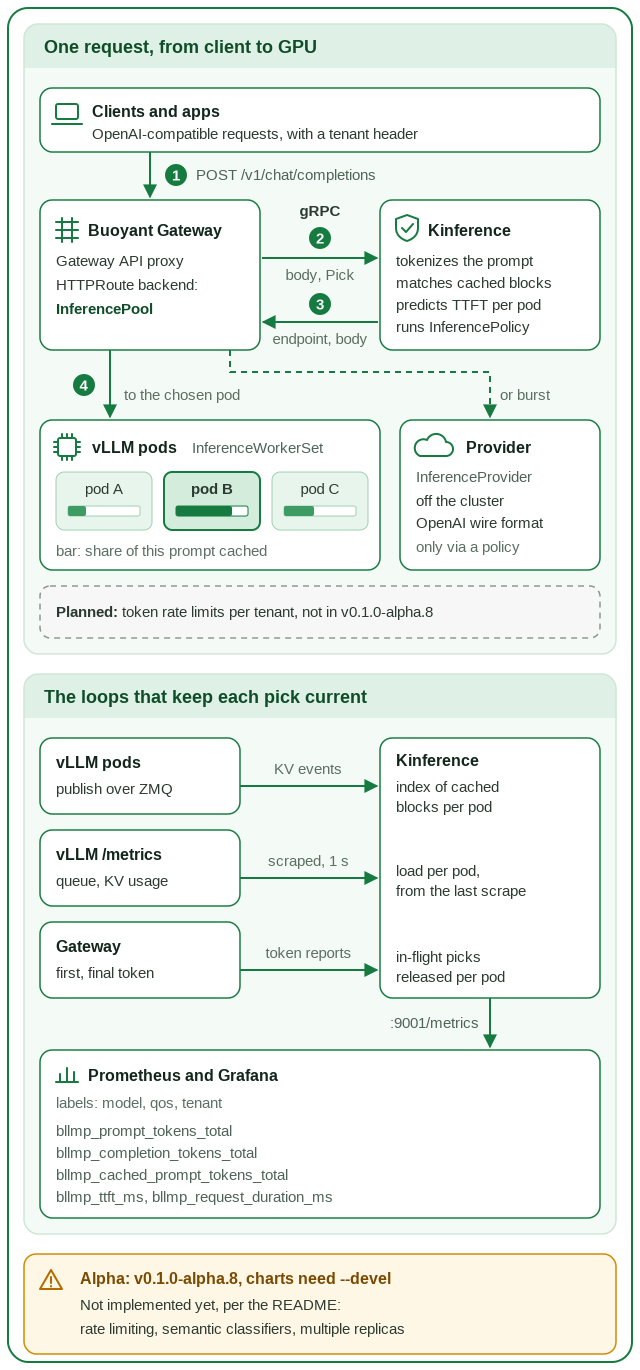
The figure shows the result. The top panel follows one request in four numbered steps. The bottom panel shows the feedback that keeps the routing decisions current.
What Kinference is#
Kinference was announced on the vLLM blog on 4 November 2026. It is built by Buoyant and licensed under Apache 2.0. The project calls it an inference control plane: vLLM still does the inference, and Kinference decides where each request goes and records what happened.
It has two components that are released separately:
- A traffic gateway. The getting-started guide installs the Buoyant Gateway, a Gateway API implementation. Your clients talk to it.
- An inference handler. Kinference itself. The gateway asks it, over gRPC, which endpoint should serve a request.
As of 28 November 2026 the latest version is v0.1.0-alpha.8, and the Helm charts install only with --devel. The README states the status plainly: "Kinference is alpha software. It has not seen sustained production exposure."
How it works#
You describe your fleet with four custom resources in the kinference.buoyant.io/v1alpha1 group:
- InferenceWorkerSet wraps the Service of one vLLM deployment, with its KV block size and optional model aliases.
- InferencePool groups worker sets and providers. A Gateway API
HTTPRoutepoints at the pool as its backend. - InferencePolicy decides, per request, which candidates count and how the winner is chosen. It is attached to a pool.
- InferenceProvider describes an endpoint outside the cluster, for example a hosted model service.
For each request, the gateway streams the body to Kinference and calls Pick. Kinference tokenizes the prompt, matches its blocks against what each pod has cached, reads each pod's load from the last metrics scrape, predicts the time to first token (TTFT) per pod and runs the policy. It returns the endpoint and a possibly rewritten body, for example with an alias resolved to the real model name. The gateway sends the request there and later reports the first and the final token back.
The cache view comes from vLLM itself: each pod publishes KV cache events over ZMQ, and Kinference keeps an index of the blocks per pod. Routing by predicted TTFT is the default, with no policy at all.
What works today, and what is announced#
The launch post lists more than the current release contains. The project's own documentation is the better guide, as of 28 November 2026:
| Feature | Status in v0.1.0-alpha.8 |
|---|---|
| KV cache-aware routing by predicted TTFT | Available, the default |
| Inference policies: match, consider, exclude, select | Available |
| Model aliases | Available |
| Burst to an off-cluster provider | Available, through a policy. The alpha.8 docs support the OpenAI wire format only |
| Token, cached token and latency metrics per tenant | Available |
kinfctl check to lint policies | Available |
| Token rate limits per tenant | Planned. The docs: "This feature will be available in a future Kinference release." |
| Semantic classification (PII, prompt complexity) | Planned, same note in the docs |
| Multiple replicas | Not yet, per the README's known limitations |
The README lists rate limiting, semantic classifiers and multiple replicas as not yet implemented. Two of the three policy examples in the launch post depend on semantic classifiers.
There is no cost calculation per tenant. What you get are token counters per model, QoS class and tenant, including cached prompt tokens, which lets you estimate cost with your own price per token.
Where it is useful, and where not#
Useful when:
- Many requests share a prefix. Agents with long system prompts, multi-turn chats and RAG over shared documents benefit when the request lands on the pod that already holds the prefix. Buoyant's own benchmark reports a 95% lower median TTFT than standard Kubernetes Service load balancing on a shared-prefix workload at light load, and about 65% on a multi-turn workload. That is the vendor's measurement; I did not reproduce it.
- Several teams share GPUs. Policies can match on tenant and model, and the metrics show who used what.
- You want a fallback. A policy can send traffic to a provider when local pods are saturated.
Not a fit, or not yet:
- Hard quotas per team. Token rate limits are planned, not shipped. Today you can see usage per tenant, not cap it.
- Production with high availability needs. Alpha, one replica, and charts that need
--devel. - Engines other than vLLM. SGLang and TensorRT-LLM are mentioned only as future options.
- One small model on one GPU. With a single pod there is nothing to choose between.
How to use it#
The example below is taken from the official documentation and was not run here: it needs a Kubernetes cluster with GPUs and a vLLM deployment. Installation in the getting-started guide is one kubectl command and four Helm commands: the Gateway API CRDs, the gateway CRDs and the gateway, then the Kinference CRDs and Kinference with --set extension.enabled=true.
First, vLLM must be recent (the guide names 0.28.0 or later) and must publish KV events and prompt token details. The documentation checks for these two arguments on the vLLM deployment:
--kv-events-config={"enable_kv_cache_events":true,"publisher":"zmq","endpoint":"tcp://*:5557","replay_endpoint":"tcp://*:5558","topic":"kv@"}
--enable-prompt-tokens-details
Then wrap the vLLM Service in a worker set, put it in a pool with a provider, and attach a policy:
apiVersion: kinference.buoyant.io/v1alpha1
kind: InferenceWorkerSet
metadata: { name: qwen-vllm-ws, namespace: default }
spec:
  profile: default
  kvBlockSize: 16
  serviceRef: { name: qwen-vllm, port: http }
  kvEvents: { port: kv-pub }
  models:
    - name: Qwen/Qwen2.5-32B-Instruct-AWQ
      aliases: [qwen-2.5]
---
apiVersion: kinference.buoyant.io/v1alpha1
kind: InferencePool
metadata: { name: inference-pool, namespace: default }
spec:
  destinations:
    - { kind: InferenceWorkerSet, name: qwen-vllm-ws }
    - { kind: InferenceProvider, name: databricks }
  policyRef: { name: local-first }
---
apiVersion: kinference.buoyant.io/v1alpha1
kind: InferencePolicy
metadata: { name: local-first, namespace: default }
spec:
  rules:
    - name: local-first-then-provider
      route:
        exclude:
          - name: drop-busy-pods
            drop:
              backend: { type: Local }
              queuedPrompts: { greaterThan: 4 }
          - name: drop-pods-without-kv-headroom
            drop:
              backend: { type: Local }
              kvCacheUsage: { greaterThan: 0.9 }
        select:
          - { type: Local, minimize: PredictedTTFT }
          - { type: Provider, order: [databricks] }
What this produces, per the policy reference: a local pod with more than four queued prompts or more than 90% KV cache usage, both averaged over 30 seconds, is dropped. The first select tier picks the remaining local pod with the lowest predicted TTFT. Only when no local pod survives does the second tier send the request to the databricks provider. If neither tier has a candidate, the request is rejected, because onEmpty defaults to Reject. The databricks InferenceProvider and the GatewayBackend that holds its URL and API key secret are separate resources, left out here. The policy is the reference example without its PII rule, because that rule needs the classifiers that are not in alpha.8. A provider is never chosen without a policy: the default policy considers local endpoints only. The policy reference is not consistent about which candidates an unset consider includes, so run kinfctl check --pool default/inference-pool on the policy and read its status.warnings after applying it, to confirm the provider tier can be reached.
Last, a Gateway with the class buoyant-gateway and an HTTPRoute that sends /v1/chat/completions to the pool, both shown in full in the basic serving guide. Clients then call the gateway Service with an ordinary chat completions request, using qwen-2.5 as the model name.
To track tenants, tell Kinference which header carries the tenant id. The docs use l5d-client-id, the client identity header of the Linkerd service mesh:
helm upgrade -i kinference oci://cr.kinference.ai/kinference-ai/charts/kinference \
  --devel --reuse-values --set extension.tenantHeader=l5d-client-id --wait
Two warnings from the docs. Kinference trusts that header unconditionally, so make sure clients cannot set it themselves. And per-tenant metrics create about 91 series per combination of model, QoS class and tenant. The docs disagree on whether per-tenant metrics are on by default, so set the Helm value config.metrics.tenant_labels to an explicit allowlist, for example {alice,bob}, rather than relying on the default.
Pros, cons and limits#
| Aspect | Details |
|---|---|
| Maturity | Alpha, v0.1.0-alpha.8 as of 28 November 2026. Helm charts need --devel. No GitHub releases yet. One replica only. |
| Pros | Cache-aware routing without code. Policies are YAML you can review, lint with kinfctl check and keep in git. Per-tenant token and latency metrics with a Grafana dashboard. Apache 2.0. |
| Cons | Token rate limits and semantic classifiers are announced but not shipped. Providers use the OpenAI wire format only, per the alpha.8 docs. The docs are still catching up with the code in places. |
| Lock-in | The CRDs are Kinference's own, not a Kubernetes standard. The getting-started guide pairs it with the Buoyant Gateway, and a provider needs that gateway's GatewayBackend resource for its URL and credentials. |
| Operations | You set the KV block size by hand per worker set, and it must match the block size of the KV events, which is not always vLLM's --block-size. Per-tenant metrics can strain Prometheus. |
| Pricing | Open source, no licence cost. You pay for the GPUs and any provider you burst to. |
When to choose it#
Try it now in a test cluster if you run several vLLM pods for shared or prefix-heavy traffic and you want cache-aware routing, a provider fallback and usage per tenant without writing your own gateway. Pin the chart version, because alpha releases can change the CRDs.
Wait if you need per-tenant quotas, PII-based routing or a highly available control plane today. Those are the features the README lists as missing, and they are what a shared production platform needs most. Check the README's known limitations before each upgrade.
Next step: the getting-started guide (opens in a new tab), then the policy reference (opens in a new tab) before you write your first InferencePolicy.